Catapult HLS (Siemens EDA), Stratus HLS (Cadence), and Vitis HLS (AMD) all compile C++-based hardware descriptions into RTL, but they are built for different situations. Catapult and Stratus are general-purpose tools documented for ASIC as well as FPGA targets, and both accept SystemC in addition to C++. Vitis HLS accepts C and C++ and is built for AMD adaptive SoCs and FPGAs.
In practice the choice is usually settled by the target technology and the EDA flow a team already runs, and only then by language, verification, and licensing differences. This guide compares the tools on those points using each vendor's own documentation. It is not a benchmark and makes no quality-of-results claims. For how HLS turns C++ into RTL in the first place, see What is High-Level Synthesis?
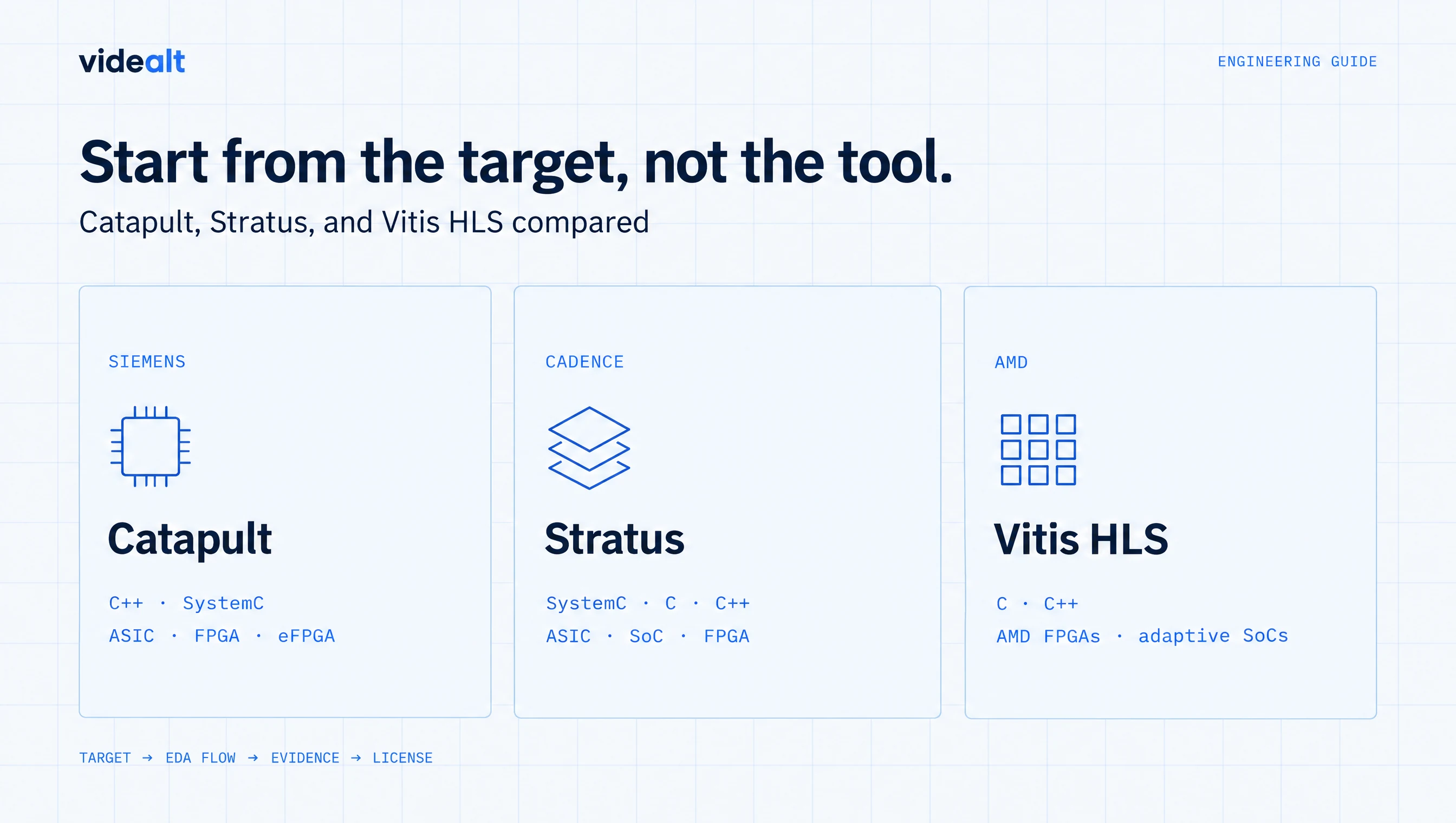
Read the diagram as text
Start from the target, not the tool
- Catapult (Siemens)C++ and SystemC input; ASIC, FPGA and eFPGA targets.
- Stratus (Cadence)SystemC, C and C++ input; ASIC, SoC and FPGA targets.
- Vitis HLS (AMD)C and C++ input; AMD FPGAs and adaptive SoCs.
The three tools at a glance
| Criterion | Catapult HLS | Stratus HLS | Vitis HLS |
|---|---|---|---|
| Vendor | Siemens EDA | Cadence | AMD |
| Input languages | C++ and SystemC | SystemC, C, and C++; a MATLAB flow is also offered | C and C++11/C++14 |
| Documented targets | ASIC, FPGA, and eFPGA | ASIC, SoC, and FPGA | AMD adaptive SoCs and FPGAs |
| Bit-accurate types | Algorithmic C types such as ac_int and ac_fixed, published as open source | SystemC data types, plus Stratus synthesizable IP for data types and math operations | ap_int and ap_fixed |
| Verification support | Catapult Coverage, formal design checks, and SLEC equivalence checking of RTL against the high-level model | Integration with Cadence simulation, and synthesis of SystemC and C++ assertions to SystemVerilog assertions | C simulation and C/RTL co-simulation that reuses the C test bench |
| Downstream flow | RTL for ASIC, FPGA, or eFPGA flows; low-power optimization built on PowerPro technology | Uses the Genus synthesis and Joules power engines for estimates | RTL IP for Vivado, or a compiled object (.xo) for the Vitis flow |
| Licensing | Commercial; no public price list | Commercial; no public price list | No license for C synthesis and simulation; a Vivado license is needed to compile the generated RTL |
Every row above comes from the vendor pages listed under primary sources. Feature sets and licensing terms change between releases, so confirm the details that matter to your decision against current documentation.
How the choice is usually made
Tool selection is rarely a free choice between three equals. Work through these questions in order, because the earlier ones tend to remove options before the later ones matter.
- What is the target? For an ASIC, the candidates in this comparison are Catapult and Stratus. For an AMD FPGA or adaptive SoC, Vitis HLS is the vendor's own tool and the usual starting point. For a design that must serve both an FPGA prototype and an ASIC, a tool documented for both avoids maintaining two sources.
- Which EDA flow is already in place? Stratus is designed to work with Cadence's Genus and Joules engines, and Catapult sits alongside Siemens verification and power tools. A team that already owns one vendor's synthesis, simulation, and power flow gets more from the matching HLS tool.
- How will the design be modeled? Untimed, sequential C++ suits algorithmic datapaths. SystemC adds explicit concurrency, clocks, and module structure, which helps with multi-process and interface-heavy blocks. Catapult and Stratus support both styles; Vitis HLS uses C and C++ with its own task, stream, and vector constructs for concurrency.
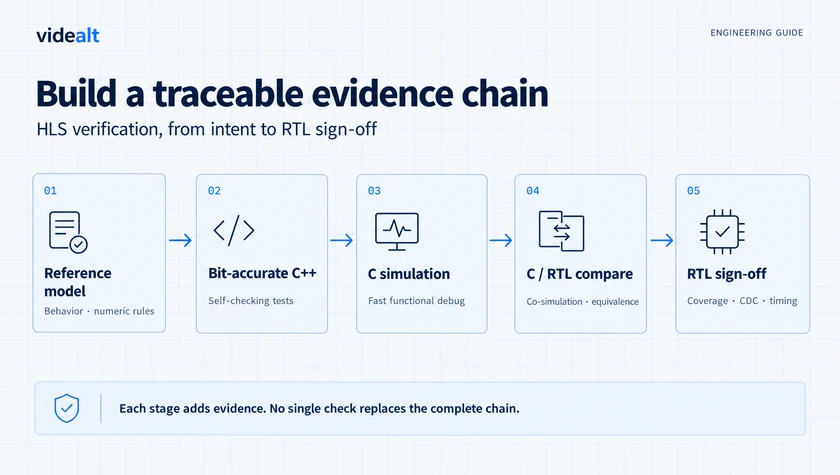
- What verification evidence is required? All three tools support simulating the source model and re-running the same tests on the generated RTL. They differ in what is available beyond that, such as source-level coverage, formal checks, and equivalence checking. Decide what sign-off needs before comparing feature lists. The HLS verification guide describes the layers involved.
- What does access cost? Catapult and Stratus are licensed commercially through the vendors. Vitis HLS is available at lower cost, with conditions described below. License availability often decides which tool a small team or a feasibility study can use.
Catapult HLS (Siemens EDA)
Siemens describes Catapult as a C++ and SystemC synthesis flow that targets ASIC, eFPGA, or FPGA implementations. It supports two modeling styles: sequential C++ using the Algorithmic C data types, and explicit concurrency in SystemC with the MatchLib library.
- Data types. The Algorithmic C types, including
ac_intandac_fixed, are published as open source under the Apache 2.0 license, so models that use them can be compiled and simulated without the tool. - Verification. The Catapult platform includes Catapult Coverage, which measures statement, branch, condition, expression, and array-access coverage on the source along with functional coverage; formal tools that check the source for mistakes and ambiguities early; and SLEC, which checks generated RTL against the high-level model for equivalence.
- Power. Catapult Low-Power provides power estimation and RTL power optimization for ASIC targets, using PowerPro technology.
Catapult is a natural candidate when the target is an ASIC, when the same source must also run on an FPGA, or when sign-off calls for source-level coverage and formal equivalence evidence.
Stratus HLS (Cadence)
Cadence describes Stratus as creating RTL for ASIC, SoC, and FPGA targets from SystemC, C, or C++ models, including a mix of untimed and timed descriptions. A flow from MATLAB to RTL, announced jointly with MathWorks, is also offered.
- Modeling. Stratus starts from transaction-level SystemC, C, or C++. Stratus synthesizable IP provides simulation and synthesis models for common bus-based and point-to-point communication protocols, mathematical operations, and data types.
- Flow integration. Stratus uses the Genus synthesis and Joules power engines, so timing, area, and power estimates during HLS reflect the technology library and the downstream Cadence flow.
- Exploration and automation. The tool can be run interactively in its IDE or in batch through Tcl, and can launch adjacent steps such as simulation, power analysis, and logic synthesis across a range of constraints.
- Verification. Stratus integrates with Cadence verification tools for mixed SystemC and RTL simulation, and can synthesize SystemC and C++ assertions into SystemVerilog assertions.
Stratus is a natural candidate for ASIC and SoC teams that model in SystemC and already implement with the Cadence digital flow.
Vitis HLS (AMD)
AMD describes Vitis HLS as synthesizing a C or C++ function into RTL for AMD adaptive SoCs and FPGAs. The user guide lists C and C++11/C++14 as the primary input and does not list SystemC.
- Modeling. Pragmas and directives control pipelining, unrolling, array partitioning, and interface protocols. Arrays can be mapped to block RAM, LUT RAM, or UltraRAM. Concurrency is expressed with HLS tasks, streams, and vectors.
- Data types. Arbitrary-precision integers and fixed-point values use
ap_intandap_fixed. AMD publishes simulation-only versions of these headers as open source. - Verification. C simulation checks the source with a C test bench, and C/RTL co-simulation reuses that test bench on the generated RTL.
- Output. The generated RTL is exported as IP for the Vivado IP integrator or Vivado IDE, or as a compiled object file (
.xo) for the Vitis application flow. - Licensing. AMD states that no license is required for C synthesis and simulation, and that compiling the generated RTL requires a valid Vivado license. From the 2026.1 release Vivado uses tiered licensing, with a free BASIC tier that covers 7 series and low-end UltraScale and UltraScale+ devices and is renewed annually.
Vitis HLS is the natural candidate when the design will only ever run on AMD devices, and it is a low-cost way to learn HLS concepts that carry over to the other tools.
Moving source between tools
The algorithm in an HLS design is usually portable. The layer that connects it to a particular tool is not. Three things differ:
- Bit-accurate data types.
ac_intandac_fixed,ap_intandap_fixed, and the SystemC types have different names, template parameters, and rounding and overflow options. - Interfaces and streaming. Each tool has its own channel or stream classes and its own way of mapping function arguments to hardware protocols.
- Pragmas and directives. Loop pipelining, unrolling, and memory mapping are expressed with tool-specific pragmas, attributes, or Tcl directives.
A design that keeps these behind type aliases and thin interface wrappers can be ported as a contained task. A design with tool-specific types and pragmas spread through the algorithm cannot. Either way, each port needs its own constraints, optimization, and verification, because the same source will not produce the same schedule in a different tool. The RTL-to-HLS migration guide covers the related problem of preserving an integration contract across a rewrite.
Comparing quality of results
No documentation-based comparison can say which tool produces the smallest, fastest, or lowest-power hardware. Results depend on the block, the coding style, the constraints, the target technology, and how well the designer knows the tool. Published comparisons seldom control for all of these.
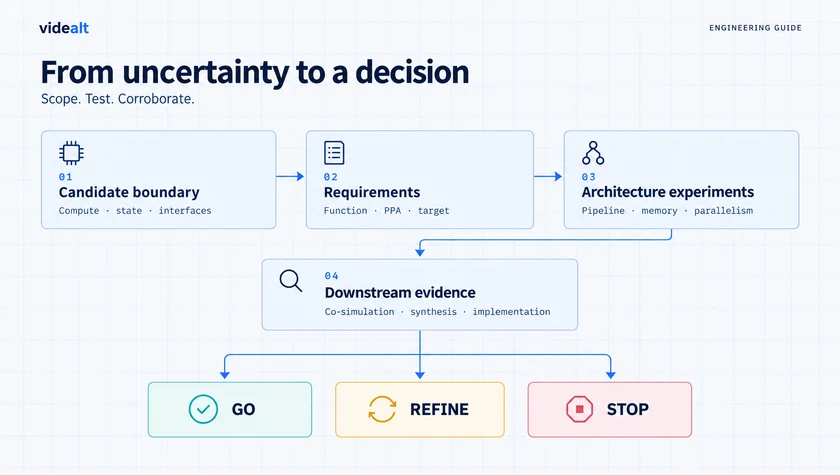
The reliable method is an experiment: take a representative block, write it for each candidate tool with comparable effort, and compare results after downstream synthesis or implementation, not from HLS estimates alone. An HLS feasibility study is a bounded way to run that experiment and to define the acceptance criteria before any tool is committed to.
Frequently asked questions
Which HLS tools are used for ASIC design?
Of the three tools compared here, Catapult HLS from Siemens EDA and Stratus HLS from Cadence are the ones documented for ASIC targets. Both also list FPGA targets. Vitis HLS is built for AMD adaptive SoCs and FPGAs and its output is packaged for the Vivado and Vitis flows.
Which HLS tool should I use for an AMD FPGA?
Vitis HLS is the usual starting point, because it is AMD's own tool and exports IP directly into Vivado and Vitis. Catapult and Stratus are worth evaluating when the same source must also serve an ASIC, or when the team already has a flow built around one of them.
Does Vitis HLS support SystemC?
The Vitis HLS user guide lists C functions written in C and C++11 or C++14 as the primary input and does not list SystemC. Catapult and Stratus both accept SystemC as well as C++.
Can the same C++ source be used in Catapult, Stratus, and Vitis HLS?
The algorithm usually can, but the tool-specific layer cannot. Bit-accurate data types, streaming and interface classes, and pragmas or directives differ between the tools. Keeping those behind type aliases and thin wrappers makes a later port a contained task, and each port still needs its own constraints, optimization, and verification.
Is Vitis HLS free?
AMD states that no license is required for C synthesis and simulation in Vitis HLS, and that compiling the generated RTL requires a valid Vivado license. From the 2026.1 release Vivado uses tiered licensing, with a free BASIC tier that covers smaller devices and is renewed annually. Check AMD's current licensing page before planning around this.
Which HLS tool gives the best quality of results?
There is no vendor-neutral answer. Area, timing, and power depend on the block, the coding style, the constraints, the target technology, and the designer's experience with the tool. The reliable method is to synthesize a representative block in the candidate tools and compare downstream implementation results.
Primary sources and further reading
- Siemens: Catapult High-Level Synthesis and verification
- HLS Libs: Algorithmic C data types (Apache 2.0)
- Cadence: Stratus High-Level Synthesis
- Cadence: Stratus High-Level Synthesis datasheet
- AMD: Vitis HLS
- AMD Vitis HLS user guide (UG1399): working with sources
- AMD: Vivado licensing options
- AMD: HLS arbitrary-precision types for simulation (Apache 2.0)